
Subterranean Termite Treatment in Hialeah, FL
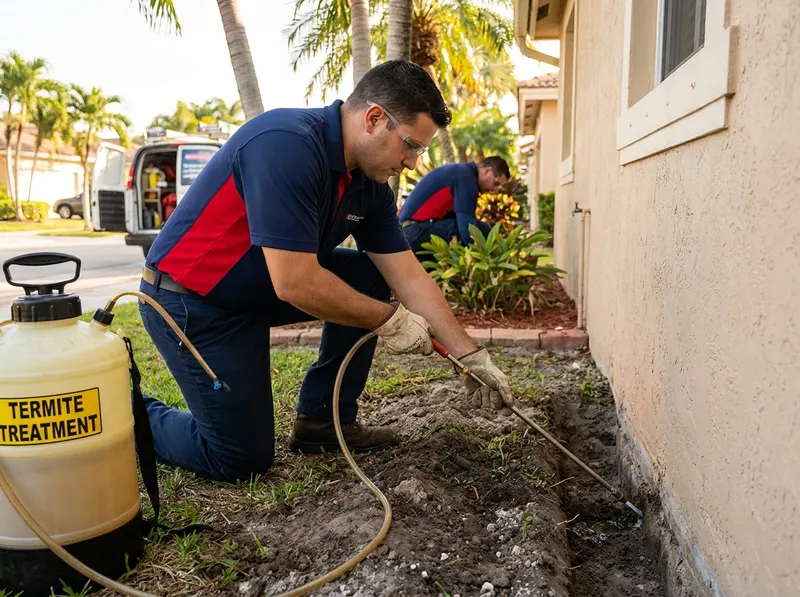
- What's included: full exterior and interior inspection for mud tubes and damaged wood, a written treatment plan, application of a soil termiticide barrier and/or in-ground bait stations, and a plain-language explanation of the product used and where it went.
- How fast: inspections in Hialeah are usually scheduled within a day or two, and most single-family slab homes are treated in one visit of roughly three to six hours depending on how much trenching and drilling the perimeter needs.
- What it costs: localized spot work starts at a $250 minimum, and full perimeter liquid treatment on a typical Hialeah slab home generally runs in the $1,200-$2,600 range — a ballpark, with the exact figure confirmed on-site.
- What we treat: subterranean termites reaching wood from the soil, including mud tubes on block stem walls, activity at patio slab expansion joints, damage around door frames, and colonies feeding on buried wood, fence posts and form boards.
- How to book: call or text (239) 456-8046 to set the free inspection. Same person answers, English or Spanish, and you get the price before any work starts.
Subterranean termites in Hialeah have easy conditions to work with. Most homes here sit on slab-on-grade concrete over sandy fill, the water table is shallow, and irrigation plus A/C condensate keeps the soil beside the foundation permanently damp. That damp band along the wall is the highway. From there, termites follow expansion joints, plumbing penetrations and hairline slab cracks up into baseboards, door jambs and any wood touching the ground. In older block duplexes around East Hialeah and the Bucky Dent Park area, we most often find activity where a patio slab was poured tight against the house years later, or where a planter bed was built up against the stem wall and buried the weep line.
The first decision is which termite you actually have, because the treatments are not interchangeable. <strong>Subterranean termites need soil contact and leave mud tubes and gritty soil-colored shelter tubing</strong>; drywood termites live entirely inside the wood and drop tiny pellets on windowsills. Swarmers appear on windows for both, so the inspection looks for mud tubing on the foundation, hollow-sounding wood at floor level, and moisture at the slab edge. Treating the wrong one wastes your money, which is exactly the complaint we hear from people who already paid somebody once.
The second decision is <strong>liquid soil barrier versus bait stations</strong>. A liquid treatment means trenching the soil around the perimeter and drilling through patio and driveway slabs where they abut the house, then charging that ground with termiticide at label rate. It works fast and it protects the whole footprint, but it is more invasive — there will be small patched holes in concrete. Bait stations go in the ground around the structure, get checked on a schedule, and eliminate the colony more gradually with no drilling. Baits fit homes with heavy landscaping, pavers, or a well where trenching is awkward, and they suit owners who want ongoing monitoring instead of one big event. Liquid fits active infestations you want stopped now. On a lot of Hialeah properties the honest answer is a combination: liquid where the activity is, stations along the fence line where the soil stays wettest.
Geography changes the plan more than people expect. Newer homes near Palm Springs North and the Country Club of Miami stretch often have wide post-tension slabs that must be drilled carefully, and homes along the Miami Lakes border area and near Lake Michelle sit close to canal banks where soil stays saturated and colonies are large. Tight lots in West Hialeah, Palm Springs and Melrose Park mean the neighbor's fence posts, mulch beds and buried debris are part of your problem, so we point out what to move away from the wall. <strong>You do not need to leave the house for a soil treatment</strong> — the product goes in the ground and under slab edges, not sprayed through your living space — and we tell you the product name, where it was applied, and what to keep pets off of while it dries. <strong>No long contract is required for a one-time liquid treatment</strong>; bait systems are the only part with a yearly renewal, and you decide on that after the first year. Find the entry point. Stop the pest.
Call (239) 456-8046Subterranean Termite Treatment pricing in Hialeah
| On-site termite inspection and written quote | no charge |
| Localized / spot treatment, one area (minimum charge) | $250 - $600 |
| Partial perimeter or slab-crack injection, duplex unit or small home | $600 - $1,200 |
| Full liquid soil barrier, typical Hialeah slab home | $1,200 - $2,600 |
| In-ground bait station system installed, first year | $1,000 - $2,400 |
| Bait station monitoring and renewal, per year | $250 - $500 |
Exact price confirmed free on-site before any work.
Subterranean Termite Treatment — questions, answered
How do I know it's subterranean termites and not drywood termites in my Hialeah home?
Subterranean termites leave mud tubes — thin ribbons of packed soil running up the block stem wall, along the slab edge, or inside a garage corner. Drywood termites leave small hard pellets on windowsills and floors instead. In Hialeah both swarm in the warm months, so the inspection checks the foundation line and moisture points before anything is quoted, because the two pests get completely different treatments.
Does subterranean termite treatment in Hialeah require tenting the house?
No. Tent fumigation is for drywood termites living inside the wood. Subterranean termites are treated at the soil — trenching around the perimeter, drilling patio or driveway slabs where they meet the wall, and injecting termiticide, or installing in-ground bait stations. Hialeah homeowners stay in the house for this work, and no food or furniture needs to be bagged.
How much does subterranean termite treatment cost for a Hialeah duplex?
Ballpark, a single duplex unit with activity in one area usually falls between $600 and $1,200, and treating the full perimeter of both sides typically runs higher, in the $1,200-$2,600 range. The minimum charge is $250. Exact pricing depends on linear footage of foundation, how much concrete has to be drilled, and whether one or both units are involved — confirmed on the free on-site visit in Hialeah.
Is the treatment safe for my kids and my dog in a small Hialeah yard?
Yes, when applied to label. The termiticide goes into the soil and under slab edges, then is covered back over — it is not fogged through living space. In tight Hialeah and Hialeah Gardens yards we walk the family through which strips of soil to keep pets off until the area is backfilled and dry, and we tell you the exact product name so you can read it yourself.
Why do subterranean termites keep coming back to homes near the Miami Lakes border and canal areas of Hialeah?
Constantly damp soil. Near the Miami Lakes border area, Lake Michelle and Hialeah's canal banks, the water table sits high and irrigation keeps the ground beside the foundation wet year-round, which supports large colonies. That is why treatment includes finding the moisture and wood-to-soil contact — mulch piled against the wall, buried form boards, wet planter beds — instead of only applying product and leaving.